Review
4 min readThompson Bros Williamson 2010 15yo: What It Is and Who It's For
Williamson is teaspooned Laphroaig sold as an Islay blended malt. This Thompson Bros release spent two of its fifteen years in Malaga cask and was bottled at 57.1% ABV in an outturn of 342. We have not tasted it; the tasting notes below are the retailer's and are attributed as such.
Verdict
A 342-bottle Thompson Bros release of teaspooned Laphroaig, finished two years in Malaga cask at 57.1%. We have not tasted it. This page explains what Williamson actually is, what the bottler's notes report, and who should chase a bottle.
What it is
Teaspooned Laphroaig, bottled as an Islay blended malt by Thompson Bros of Dornoch
The numbers
15 years old, 2 of them in Malaga cask, 57.1% ABV, 342 bottles
Have we tasted it?
No. Notes below are the bottler's and the retailer's, attributed in the text
This page contains affiliate links. As an Amazon Associate we earn from qualifying purchases, and we may earn a commission from other retailers, at no extra cost to you. It never affects which bottles we recommend — see our affiliate disclosure.
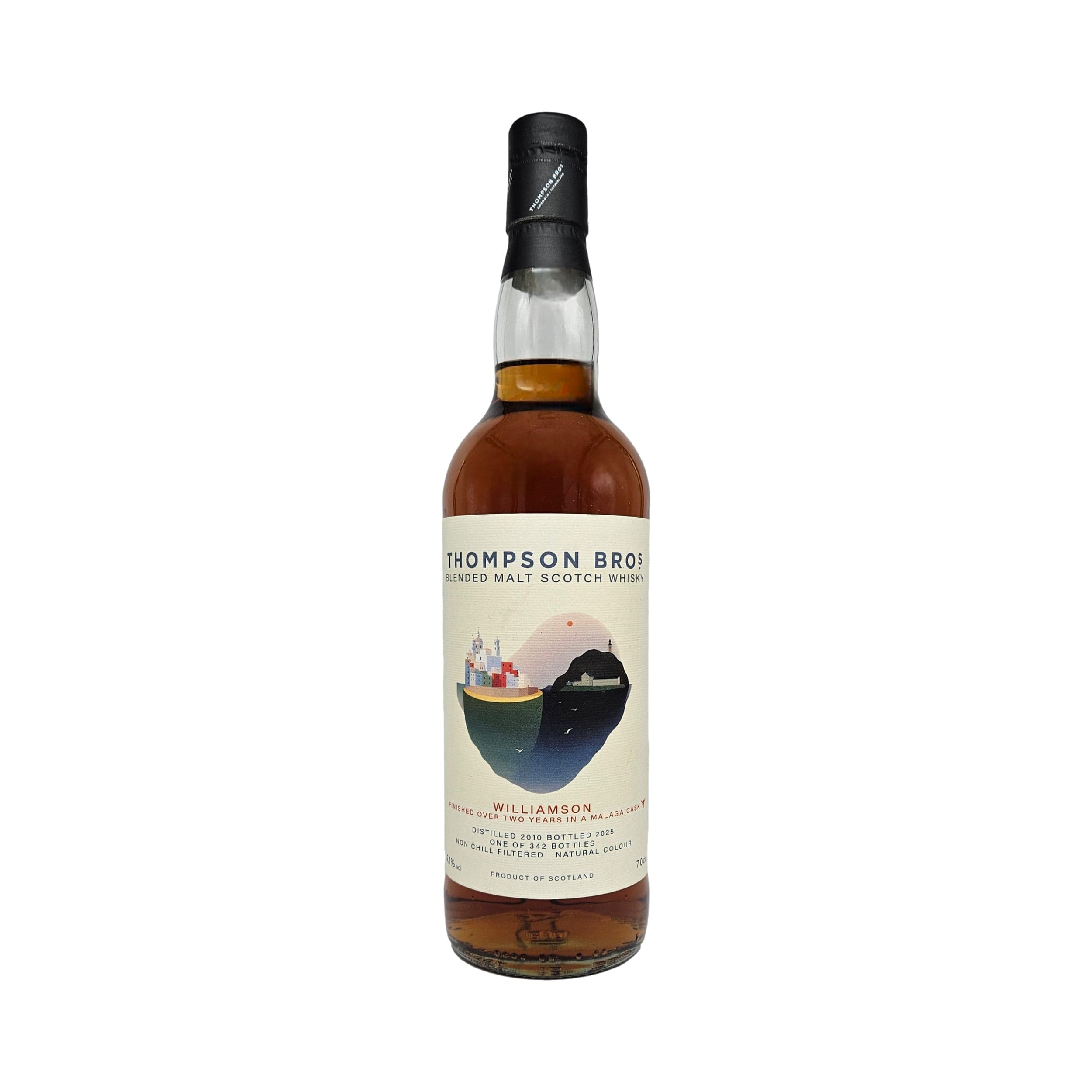
Shop this bottle
Thompson Bros Williamson 2010 15 Year Old
A 342-bottle Thompson Bros release of teaspooned Laphroaig, finished two years in Malaga cask at 57.1%. We have not tasted it. This page explains what Williamson actually is, what the bottler's notes report, and who should chase a bottle.
What Williamson actually is
Most listings do not mention this, and it changes what you are looking at.
Williamson is teaspooned Laphroaig. Retailers list it as "Williamson (Laphroaig)" precisely because that is what is in the bottle. Teaspooning is the trade practice of adding a token amount, traditionally a teaspoon, of another distillery's malt to a cask before it is sold on. That tiny addition means the whisky can no longer legally be called a single malt from the original distillery, so it must be sold as a blended malt under a trade name instead.
Distilleries do this when they sell casks to brokers and independent bottlers. It protects the brand while still letting the stock find a market. Laphroaig's teaspooned stock travels under the name Williamson, generally taken as a nod to Bessie Williamson, the manager who inherited the distillery from Ian Hunter in 1954 and became the first woman to own and run a Scotch whisky distillery in the twentieth century. That link is the accepted reading rather than anything Laphroaig has ever confirmed.
So: when you read "Islay blended malt" on a Williamson label, you are looking at Laphroaig wearing a different coat.
Who Thompson Bros are
Phil and Simon Thompson run Dornoch Distillery in the Highlands, built into the old fire station of the family's Dornoch Castle Hotel, whose whisky bar built the reputation that came before the distilling did. Alongside their own spirit they bottle other distilleries' casks under the Thompson Bros name.
Their selections have a consistent character: they tend toward casks that are distinctive rather than polished, and they are not afraid of a bottling that divides opinion. That reputation is the main reason a release like this sells through quickly.
What the notes report
We have not tasted this whisky, and of everything on this site it is the bottle we would most like to get a glass of. Malaga is a sweet fortified wine, and what two years in a cask like that does to heavily peated spirit is not something you can reason out from a spec sheet. Tar and rope are what Laphroaig gives you anyway. Whether the cask sweetens that, cuts across it, or does something stranger is the entire question, and it is the reason this bottling is more interesting than most Islay releases at the price.
The Whisky Shop's tasting note reads:
The retailer's tasting note
A nose full of tar, fishing ropes, and heavy smoke, with twists of sesame seed and miso syrup.
Those descriptors are worth reading carefully rather than skimming. Tar and rope are conventional Laphroaig markers. Sesame and miso are not. They point toward a savoury, umami register, which is the sort of direction a Malaga cask might push a peated spirit given it previously held sweet fortified wine.
The numbers, and what they imply
Fifteen years old, two of them in Malaga cask, bottled at 57.1% ABV, in an outturn of 342 bottles.
The cask-strength bottling means no dilution decisions have been made for you. The two-year finish is long enough to leave a mark but short enough that the underlying Islay spirit should still lead. At 342 bottles this is not a release anyone will be casually restocking.
Who should chase a bottle
Worth setting an alert for if you already know you enjoy cask-strength Laphroaig and are curious what a sweet-wine cask does to it. The combination is unusual enough to be interesting, and the bottler has the track record to make it worth the gamble.
Not the place to start if you are new to peated whisky. A 57.1% Islay malt with a wine finish is a lot to unpack, and there is no version of this that works as an introduction. Lagavulin 16 is the more sensible first serious peat purchase, and Ardbeg Uigeadail is the better-known benchmark for richer cask-strength Islay.
Probably not a value purchase. Small-outturn independent bottlings carry a scarcity premium. That is a fair trade if the scarcity is what you want, and a poor one if you are simply after good peated whisky per pound.
If it has sold through
With 342 bottles, that is the likely outcome. Rather than dropping to a supermarket Islay, the closer substitute is another independent bottling of peated Islay stock. The Whisky Exchange's exclusive and limited bottlings are worth a look. So is their Islay single malt range, if you would rather have a distillery release you can actually buy.
For Thompson Bros at the opposite end of the spectrum, the Glenrothes 1997 25 Year Old shows what they do with unpeated Speyside.
Top recommendations
Bottles worth knowing
#1
Ardbeg
Islay, Scotland
A powerful Ardbeg bottling that layers Islay peat smoke with dark sweetness, sherried richness, and an oily, full-bodied texture.
Good bottle to start with
Ardbeg Uigeadail
Typical notes
Treacle, dark chocolate, dried fruit, barbecue smoke
#2
Lagavulin
Islay, Scotland
A benchmark mature Islay single malt with dense peat smoke, maritime character, subtle sweetness, and a long, layered finish.
Good bottle to start with
Lagavulin 16 Year Old
Typical notes
Peat smoke, seaweed, iodine, salt, toffee